
We Played the Same World Cup 600 Times
We wired five robot managers into the real game engine and made them play World Cup: Three Lions six hundred times. The data says the dice aren't the story. You are.

There’s a claim we make about 90 Minute Manager that sounds like marketing until you test it: the engine has no dice you can blame. Same seed, same decisions, same season, every single time. Your result is a consequence of your choices, not your luck.
Fine. Let’s test it. Properly.
We took World Cup: Three Lions, the knockout challenge where England enter the 2026 quarter-finals with Harry Kane on six goals and Haaland’s Norway waiting, and we played it 600 times through the actual production engine. Not a model of the engine, the engine: the same TypeScript that runs on your phone and re-simulates your runs on our server.
The setup
A run of Three Lions is three knockout ties (Norway, then Argentina, then France in the final), threaded with the decisions that define the story: how you handle the press, how you plan for Haaland, what you do when Declan Rice’s red card and Kane’s ankle blow the campaign open. Lose once and you fly home.
We built five robot managers, each a decision policy driving the engine exactly the way a player would:
- All-out attack: attacking mentality and a high press in every match, and the riskiest option in every story decision.
- Park the bus: counter-attacking, defensive, and the safest option every time.
- Smart manager: a heuristic that adapts, pressing weaker sides, sitting in against stronger ones, chasing games when behind, shutting up shop when ahead late.
- Coin-flipper: genuinely random tactics and choices (from a seeded generator, naturally).
- Do nothing: balanced tactics, the first option in every dilemma, no substitution plan. The manager who just lets it happen.
Each policy played the same 120 tournament seeds: 600 runs, 1,431 knockout ties, 3,941 goals scored and 1,809 conceded. And because determinism is the whole point, we then replayed all 600 runs with identical inputs. All 600 came back byte-for-byte identical. Not statistically similar. Identical.
How far England got
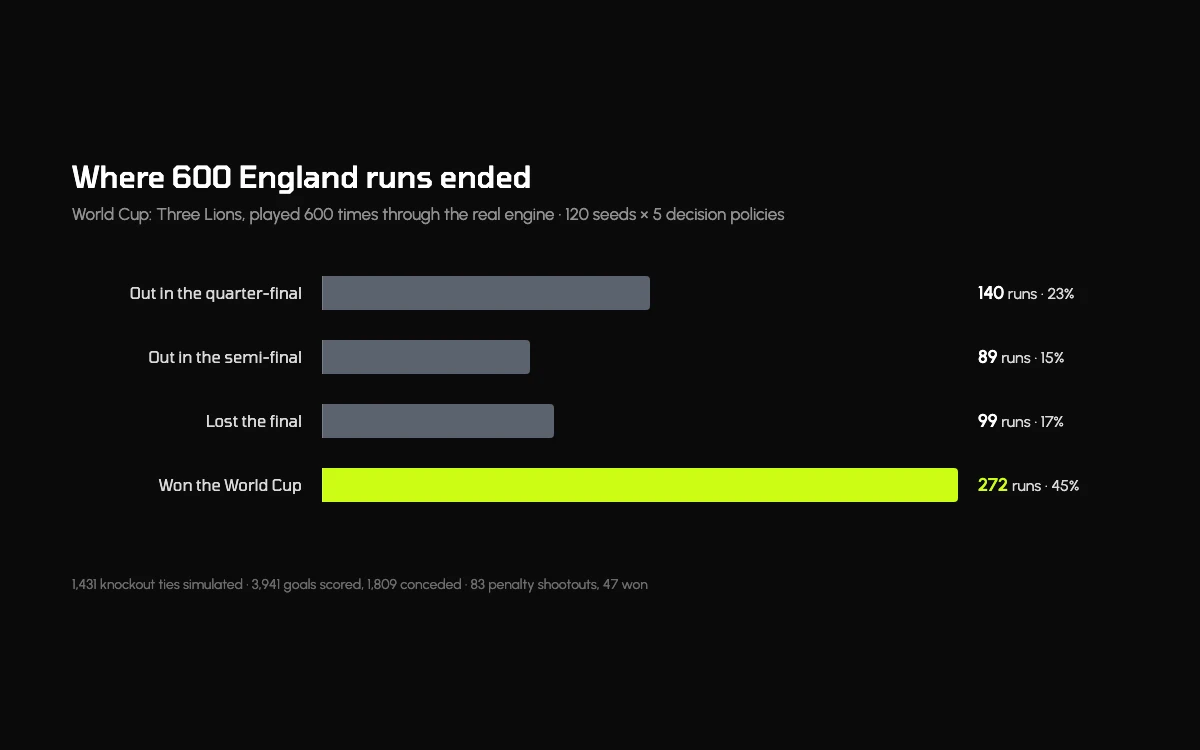
Across all 600 runs, England won the World Cup 272 times (45%), lost the final 99 times, fell in the semi 89 times, and went out to Norway in the quarter-final 140 times. The single most common scoreline against Norway was 2-1, which happened 67 times in 600 quarter-finals. Eighty-three ties went to penalties; England won 47 of them, which will surprise anyone who has followed England’s actual relationship with shootouts.
The gap between policies is where it gets interesting.
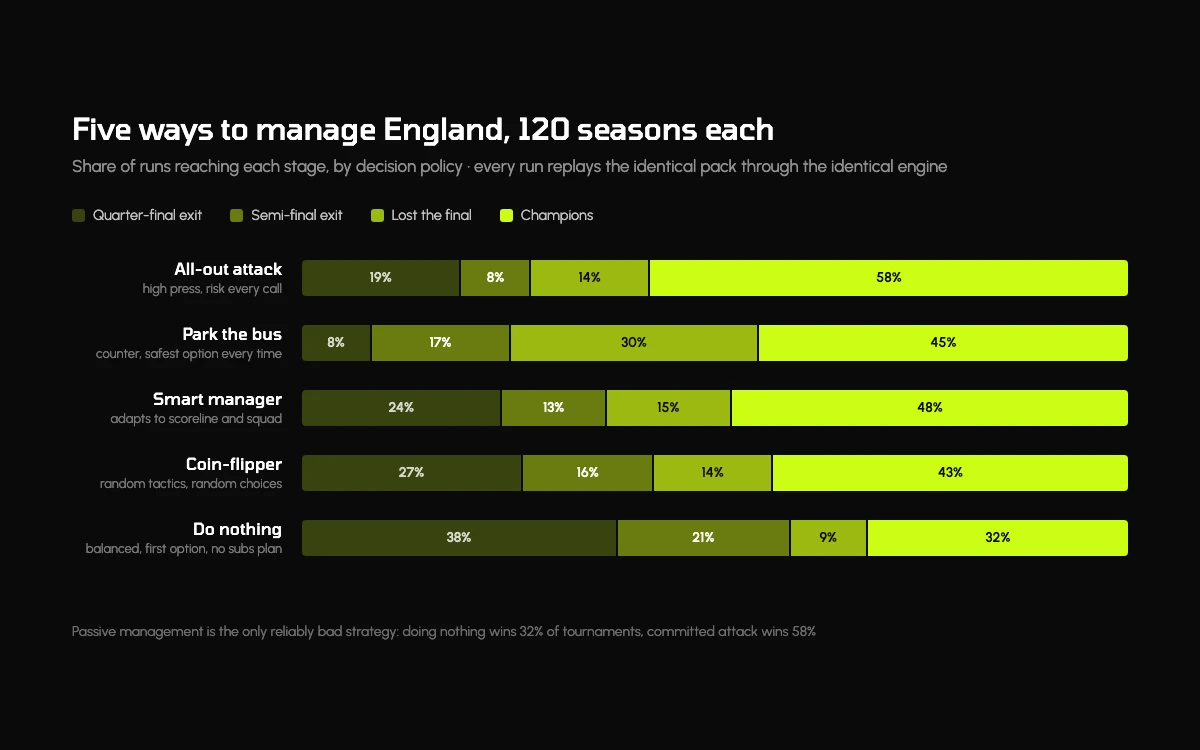
All-out attack won the tournament in 70 of its 120 worlds (58%). Park the bus won 54. The adaptive smart manager won 58. The coin-flipper won 52. And the do-nothing manager won just 38, crashing out of the quarter-final in 46 of 120 attempts.
Two things in that table changed how we think about our own game. First, passivity is the only reliably bad strategy. The coin-flipper beats the do-nothing manager comfortably, which means the engine rewards commitment to any plan over the absence of one. Even random tactical changes and random substitutions inject enough response to events to matter.
Second, the attack and defence profiles fail differently, and the shape of the failure is very football. Park the bus is the best policy at reaching the final: it got there in 90 of 120 runs, 75%, because low-risk choices rarely blow up early. But it converted only 60% of those finals. All-out attack reached the final slightly less often (87 of 120) and converted 80% of them, winning 70. Cautious football gets you to the big night; brave football wins it. We did not design that on purpose, and we grinned for about an hour when it fell out of the data.
The scoring system feels it too: attacking runs averaged 19,063 points with a median of 28,640, while the passive manager averaged 12,034 with a median of 5,470. Only 30 runs in 600 hit the Diamond medal threshold. It’s meant to be rare. It is.
One decision, 120 parallel worlds
Here’s the experiment we actually built all this for.
Before the quarter-final, the game asks you how England should prepare for Erling Haaland. One option gives Marc Guéhi a single job: shadow him everywhere. Another ignores him entirely and spends the week drilling attack. We took the smart manager, froze every other decision it would make, and played all 120 seeds twice: once with man-marking, once with the front-foot plan. Two timelines per world, differing by exactly one training-ground choice.
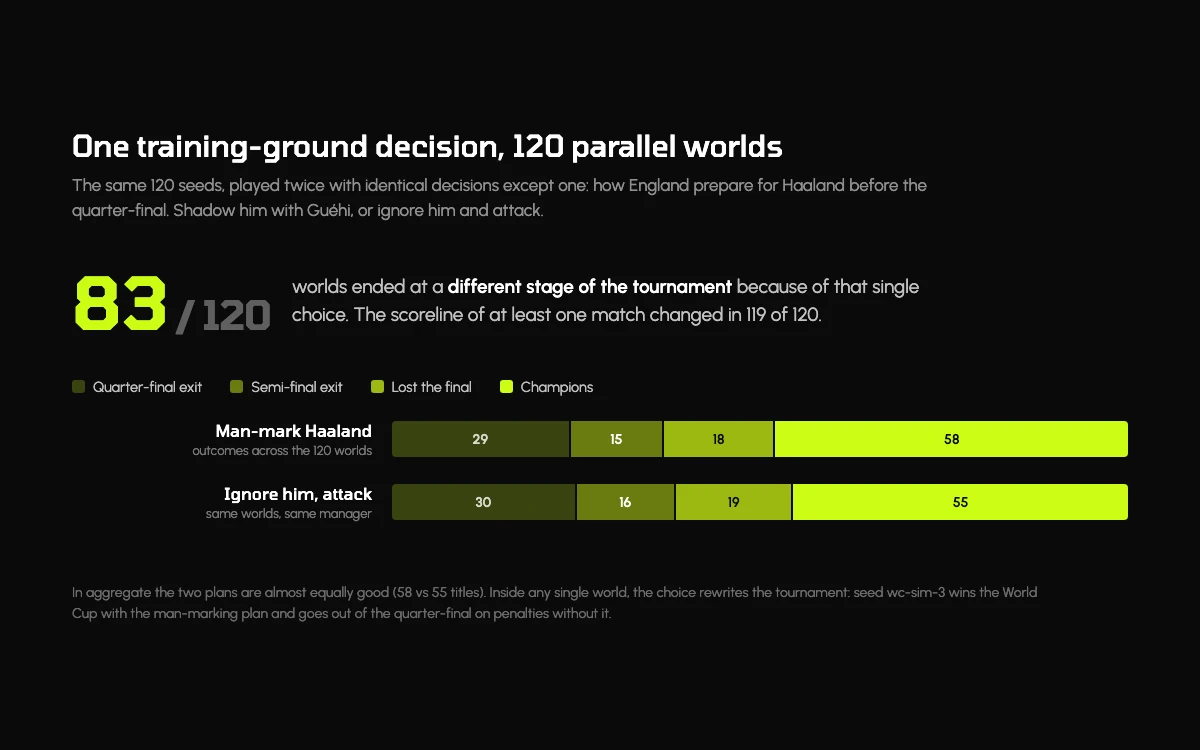
The scoreline of at least one match changed in 119 of the 120 worlds. The stage England reached changed in 83 of them, 69%. One choice, made on a Tuesday in Miami, rewrote most of the tournament’s endings.
And yet, zoom out and the two plans are almost exactly equally good: 58 titles with man-marking, 55 without, across the same 120 worlds. That’s the finding we keep coming back to. The decision barely moves your odds. It completely changes your world. Which world you get is up to you; there is no neutral choice that keeps both futures alive.
The single best anecdote in the data is seed wc-sim-3. With the man-marking plan, England beat Norway 4-1, dispatch Argentina 2-0 and win a seven-goal final against France 4-3. Champions of the world. Same seed, same manager, same everything except that one training decision: England draw Norway 1-1 and go out of the quarter-final on penalties. The distance between immortality and the quietest flight home of your life was one whiteboard session.
We ran a second, crueller version late in the story: the scan on Kane’s ankle before the final, where you either strap him up on injections or rule him out and build around Ollie Watkins. In seed wc-sim-9, both timelines are identical for two full rounds, 2-0 in the quarter, 2-1 in the semi, the same goals, the same minutes. Then the gamble on Kane loses the final 4-3, and the Watkins plan wins it 2-1. Two managers could compare notes after those runs and agree on every single thing that happened for 80% of the tournament, then discover they live in different realities.
Why any of this matters
None of this is randomness. When you change a decision, the engine doesn’t reroll some hidden global dice; every match segment draws its randomness from the world seed combined with a hash of every decision you’ve made so far. Identical choices replay identically, forever. Different choices give you a genuinely different world, deterministically. The butterfly effect isn’t a bug in the simulation; it’s the design.
This is exactly what the daily ranked mode leans on. At midnight, everyone on Earth gets the same seed. The 4,000 people above you on the leaderboard didn’t get better bounces, because there are no bounces to get. They man-marked Haaland in a world where you attacked him, and 69% of the time, that was the whole story.
The engine has no dice you can blame. We checked. Six hundred times.